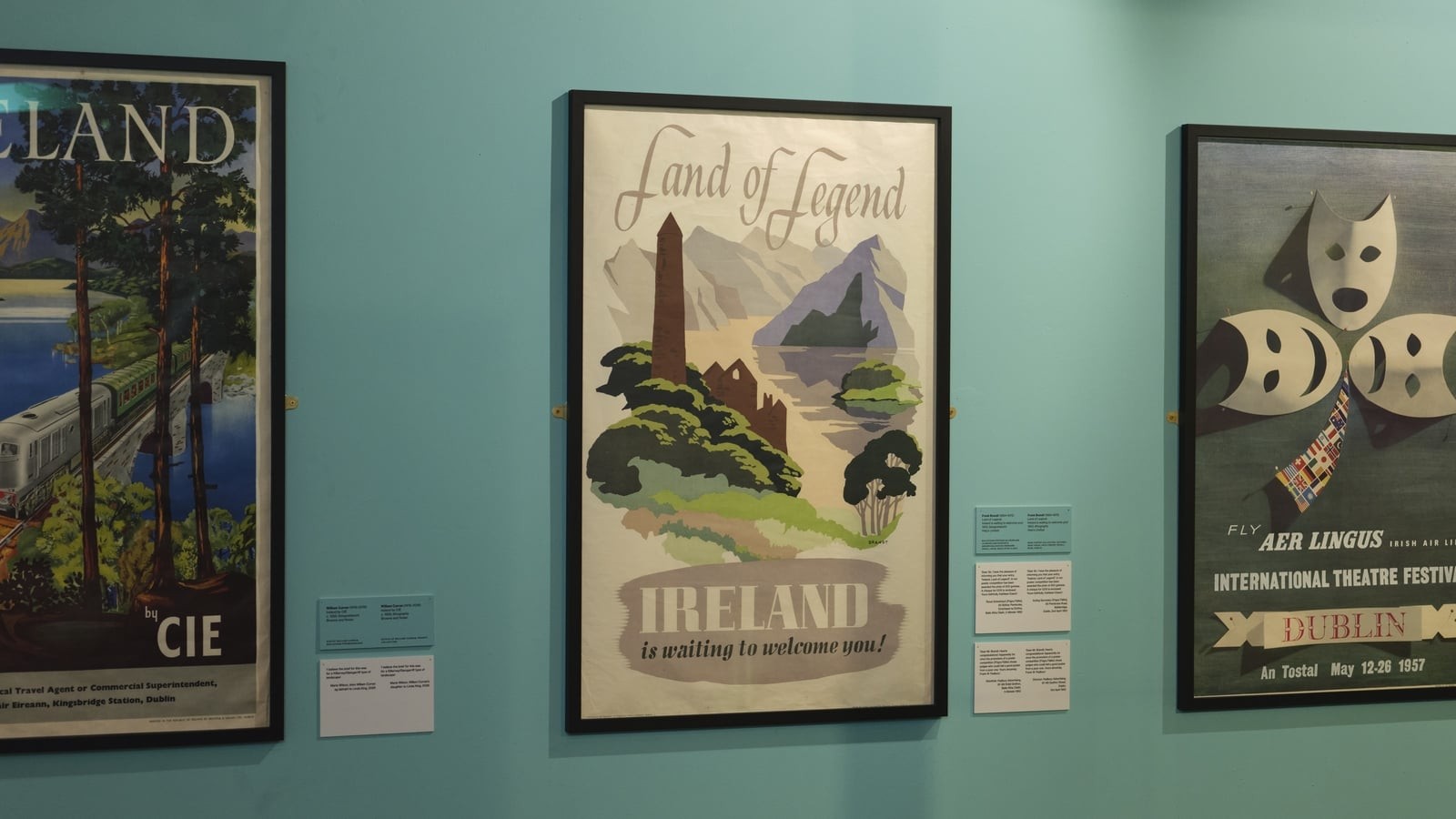
A new exhibition at the National Print Museum in Dublin is telling the overlooked story of the Dutch graphic designers who arrived in Ireland in the 1950s and went on to shape how this country saw itself, and how the world saw us. Come Fly With Me: Aviation, tourism and Irish design opened this month and runs until December 17th.
Curated around the research of Dr. Linda King, Senior Lecturer in Design and Visual Culture at IADT, the show gathers posters, brochures, postcards and original sketches from a generation of designers who gave Aer Lingus, Fógra Fáilte and a young tourism industry a visual language that was confident, modern and unmistakably Irish. According to RTE.ie, the exhibition examines Irish cultural history through aviation and tourism graphic design, a chapter that deserves far more attention than it has received.
How Dutch designers came to work for Aer Lingus
The story begins with Guus Melai, the first of the Dutch designers to arrive in 1951. He was followed by Jan de Fouw, Willem Van Velzen and Piet Sluis, among others. Most had been lured away from the publicity department of KLM, the Dutch national airline, and initially worked through an advertising agency employed by Aer Lingus. Good wages and prestigious work for the national carrier persuaded most of them to stay.
Sluis later reflected on those early years in a conversation with Linda King in 2001.
'I concentrated on my work and how to fit in here ... I was surrounded in the beginning by Dutch men and that made it a little bit easier.'
These were not drifters. They were highly skilled, design school graduates working in a modernist tradition shaped by American and European advertising. By the mid-1950s, Dublin advertising agencies were placing job offers in the Dutch press, and having a Dutch designer on the creative team became something agencies boasted about. That detail alone tells us how hungry Irish business was for visual sophistication at the time.
Why Ireland had to import design expertise
Dr. King's account, as reported by RTE.ie, is honest about why the country could not grow this talent at home. Ireland's colonial history and its lack of industrialisation meant its design industries never developed organically as they did elsewhere in Europe. The protectionist economic and cultural policies of the early Free State years, combined with an arts education system badly in need of reform, left Ireland hopelessly out of step with its European neighbours by the mid-20th century.
That changed under Seán Lemass, first as Minister for Industry and Commerce and later as Taoiseach. Lemass understood that design development was integral to economic growth, especially if Ireland hoped to join the EEC. Here was a state finally admitting that opening outward, not closing inward, was the road to prosperity. It is a lesson worth remembering today, when the temptation to pull up the drawbridge is never far from the political surface.
In that climate, there was simply no indigenous expertise experienced enough to serve a national airline with major expansion plans into Europe and the United States. The Dutch arrivals filled that gap, and they filled it well.
From Aer Lingus to Tayto: a lasting imprint
As Irish tourism expanded, the Dutch designers became sought after across the whole sector. They worked for Fógra Fáilte, the forerunner of Bord Fáilte Éireann, as well as Dublin, Cork and Shannon Airports, and John Hinde, whose postcards defined the picture-postcard Ireland of the era for generations of visitors. Soon they were designing for indigenous companies too: Tayto Crisps, Guinness, Shackelton Flours and RTÉ.
They were not entirely alone. A small number of Irish designers also worked on tourism advertising, including William Curran, Frank Brandt and the architect Pat Scott. But the importation of Dutch expertise accelerated Irish design activity in a way the domestic scene simply could not have managed on its own timetable.
The legacy runs deeper than posters. RTE.ie notes that many of the designers' children and grandchildren are now well known artists, designers and film-makers within the Irish creative community. The families the 1950s arrivals started here became part of the fabric of Irish cultural life itself.
A story about the Ireland we chose to become
What makes this exhibition worth an afternoon in Dublin is what it says about the country these images helped build. The Ireland of the Aer Lingus posters was not a backward-looking place. It was a country presenting itself to Europe and America as modern, welcoming and open for business, at the very moment Lemass was dismantling the economic walls of the previous decades.
The designers re-presented Irish culture through a modernist lens, and in doing so they helped change how Irishness was promoted both nationally and internationally. That is no small thing. A nation's self-image is built in part by the images it sends out into the world, and these were images of a republic looking forward rather than back.
It is a fitting story for our times, when cultural life on this island continues to reach across borders, and when the creative sector remains one of the genuine strengths of Irish public life, as our coverage of work like