
Irish peacekeepers return as Lebanon mission winds down
The 128th Infantry Battalion has returned to Dublin, closing Ireland’s final full battalion deployment with UNIFIL as families prepare for Christmas.
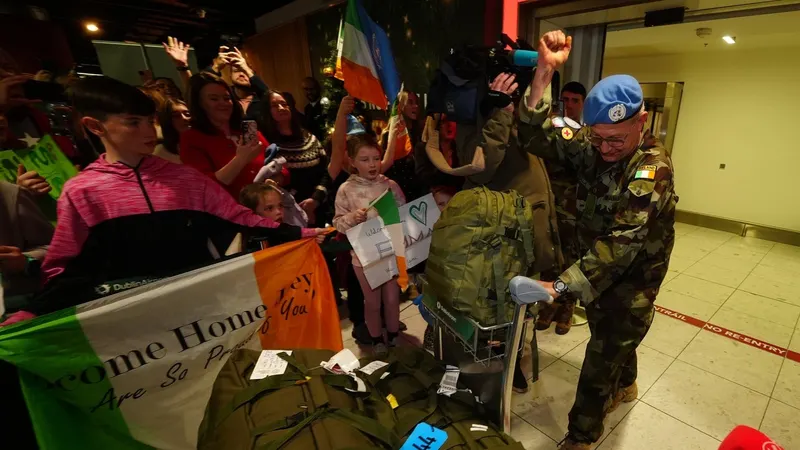
Irish peacekeepers returned to Dublin Airport on Friday, 27 November 2026, ending the final full battalion deployment to Lebanon as the United Nations mission prepares to withdraw.
The 128th Infantry Battalion landed at Terminal 1 shortly after 2pm to applause from waiting relatives, with children running forward to greet soldiers home for Christmas, RTE.ie reported. Their six-month deployment with the United Nations Interim Force in Lebanon had taken place during a volatile period in the south of the country.
A final homecoming at Dublin Airport
The arrivals hall supplied the human measure of a military milestone. Partners who had managed six months apart, young children and other relatives gathered to welcome a battalion drawn from communities across Ireland.
Company Quartermaster Sergeant Patrick Ryan, who has served in the Defence Forces for 22 years, was met by his partner, Úna Cremin, and their children, Gráinne, 10, Tiarnán, 5, and Álibhe, 4.
“It’s great to be home. I am looking forward to slotting back into family life and getting to spend more time with the lads and herself,” he said.
Ryan acknowledged the burden carried at home and said Tiarnán wanted to follow in his father’s footsteps. He also spoke about losing his father before travelling to Lebanon.
“It has been tough. I lost my father before I came out but when you go over you have the lads with you and there’s great help to focus,” he said.
He described the opening six weeks as the hardest part of the deployment, before conditions became calmer. Company Quartermaster Sergeant William Kent, from Cork, was greeted by his 3-year-old son, Sean.
“It’s great, it’s super to get home,” Kent said. “I missed this small fella and my daughter, it’s nice to be home, especially for Christmas.”
Kent called the operation busy and enjoyable, praised the people serving alongside him and wished those still in Lebanon well. Private Emma Trowell, from Galway, was welcomed by her two nieces.
“It’s great to be home. It means the world to be back to these two,” she said.
Trowell said her first stop would be a shop for snacks on the journey home. After six months away, she said she had missed everything about home.
The last full Irish battalion with UNIFIL
The battalion comprises around 344 personnel, including 16 women. For 114 members, this was their first overseas operational deployment with the Defence Forces. Its personnel came from 28 counties, with Dublin supplying the largest contingent at 43 people.
Lieutenant Colonel Damian Carroll, the battalion’s commanding officer, said the returning group was the second chalk, or movement, of the 128th Infantry Battalion to come home after its six-month tour.
“We’re the last full operational battalion that’s going to serve with UNIFIL as they commence their drawdown and withdrawal into 2027,” he said.
His description of the return was also carried in the Irish Times report. Carroll joined the Defence Forces in 1995 and was commissioned from the 72nd Cadet Class into the 12th Infantry Battalion in Limerick in July 1997.
A smaller infantry group has replaced the battalion. Its immediate task is to maintain operational capability while preparing for the drawdown, ahead of the closure of Camp Shamrock next month.
What the battalion faced in southern Lebanon
Carroll said the battalion entered Lebanon in May during a difficult security situation, shortly after hostilities began in southern Lebanon in March. A number of international peacekeepers had been killed shortly before the Irish deployment.
He said conditions gradually eased. UNIFIL moved from sustaining its own positions back into operations in local villages, assisting displaced people in southern Lebanon. Attention has since turned to preparations for withdrawal in 2027.
The Defence Forces said the battalion worked in a highly active operational area and carried out its duties professionally despite regional volatility. That formal assessment sat alongside the more personal accounts at Dublin Airport: exhausting early weeks, reliance on training and support from comrades.
An end of an era for Irish peacekeeping
Carroll repeatedly described the return as the end of an era, while stressing that Irish personnel still have work to complete in Lebanon.
“It’s the beginning of the end for the legacy of UNIFIL. It’s a poignant moment, I suppose. Ireland has such a proud history and links with Lebanon, particularly in the southern Lebanon area,” he said.
For the families at Terminal 1, that history was present in a simpler form: a parent lifting a child, a partner no longer counting months and a Christmas reunion secured. For the State, it marks a change in how a long-running international commitment will be carried through its final phase.
Carroll said the Defence Forces would bring their equipment home and prepare for whatever overseas task the Government might next assign them. The smaller Irish group, meanwhile, remains in Lebanon to maintain capability and establish the conditions for withdrawal.
Irish troops in Lebanon: what happens next?
Has every Irish peacekeeper left Lebanon?
No. A smaller infantry group has replaced the 128th Infantry Battalion. It will maintain operational capability while preparing for the drawdown and the closure of Camp Shamrock in December 2026.
Why is this return being called the end of an era?
The 128th is the last fully operational Irish battalion to serve with UNIFIL before the mission’s drawdown and withdrawal into 2027, according to Lieutenant Colonel Damian Carroll.
What will the returning Defence Forces personnel do?
They will bring their equipment home and resume preparations for future service. Carroll said they would be ready whenever the Government decides to deploy them overseas again.