
Rosalind Nashashibi, the British Palestinian artist and filmmaker, has said her new short film Occupation of the Inner Life is about what occupation does to a person's dreams, and she has defended the word genocide as an accurate description of the war in Gaza. In an interview with LRT.lt, republished by RTE.ie on 18 November 2026, Nashashibi spoke about hope, stagnation and the stubborn act of staying on one's land.
The eight-minute film screens at the Vilnius Documentary Film Festival. It was originally commissioned for public train stations in Switzerland, which shaped its form: a viewer can catch fragments between platforms and still leave with its meaning.
What the film shows
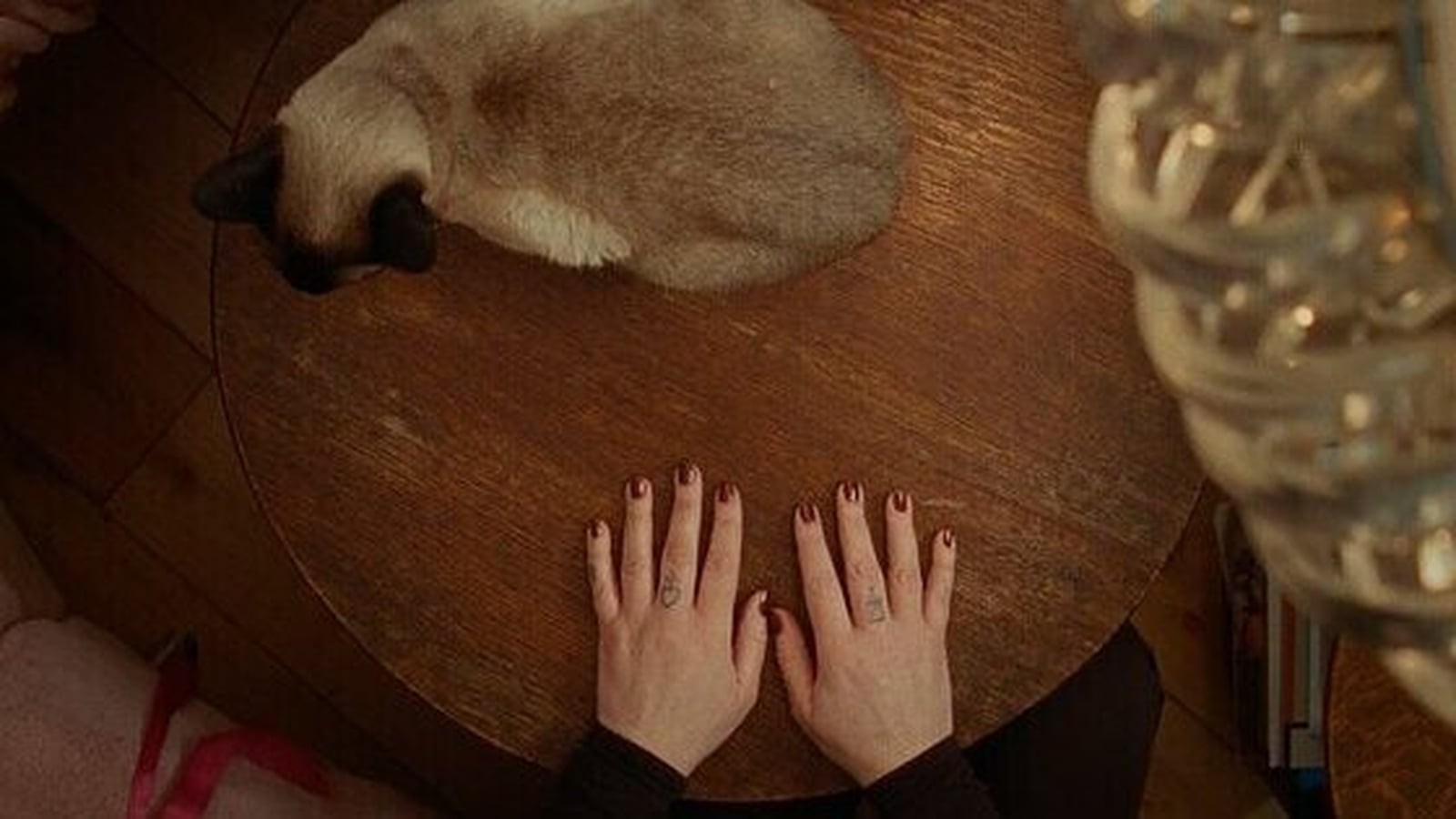
The film opens with a Tarot card reading. A young woman, Nashashibi's daughter, asks the fortune teller when love will come to her, when her situation will change. The answer is that she must wait, that her world has to expand first. The camera then drifts through Nashashibi's paintings in her London studio, works tied to Palestinian life and cultural symbols, with a recurring motif of horses. It closes on her father, alone in his house, with the artist visible in a mirror as she films.
“I think this film is about what happens to a person's dreams and inner world when they live in the context of occupation,” Nashashibi told LRT.lt.
One painting shown in the film carries the words “Wait another week” at its bottom edge. Another shows hands holding stones. For Nashashibi, these two images sit at the heart of resilience: waiting and resisting, remaining in place. She connects that endurance to a young person standing on the threshold of adult life, a threshold she imagines in Gaza or the West Bank, where even romance arrives through the language of delay.
She could not make the film in Palestine. She said she can travel elsewhere, but “now is not the time,” and of course no one can enter Gaza. The film was shot in London, in her studio and her father's home.
Why she calls it genocide
Nashashibi said she uses the term genocide without hesitation. She pointed to the United Nations International Commission of Inquiry, which has stated there is credible evidence to assert that Israel has committed genocide, and to the assessments of many genocide researchers, including Jewish Holocaust experts.
“Israel has done a very good job controlling the terminology used and making us feel as though certain words are taboo. But it is not taboo,” she said.
“What should be taboo is targeting children and other civilians with weapons of mass destruction. This has happened over the past three years.”
She acknowledged that many artists and critics fear being labelled anti-Semitic for criticising Israeli policy, a fear she called a very successful campaign by Israel. In her own circles, she said, the word apartheid for the West Bank is used normally, and solidarity outweighs hostility.
“There is no point in discussing with people for whom genocide and occupation are nothing significant,” she said.
She has likely lost some exhibition opportunities, she admitted, but she has gained from audiences in the Basque Country, Belgium and the Netherlands, places she described as open to the idea that Palestinians hold human rights too. Culture has become one front in that argument. When 55 artists and entertainment figures signed an open letter to President Joe Biden through the collective Artists4Ceasefire, they wrote that all life is sacred regardless of faith or ethnicity and condemned the killing of Palestinian and Israeli civilians alike.
Two decades of filming Palestine
This is Nashashibi's fourth film connected to Palestine. She filmed her first in 2002 at the wall between Jerusalem and the West Bank, in a no man's land. In 2003 and 2004 she filmed a Palestinian family at home in Nazareth. In 2014 she made Electrical Gaza.
The new work differs from its predecessors in one respect: it is a diary. Nashashibi said viewers who recognize the Palestinian signs will read it one way, and viewers who do not will see something else entirely, the intimate transformation of a young woman, paintings, a grandfather, a mother in the middle. The film can be viewed from different perspectives, and that was the concept.
Painting has moved to the centre of her practice. The works glimpsed in the film are her own, painted before and around the filming rather than made for it. She said she loves films where paintings can be seen, and in her recent work painting either forms a central axis or reveals the emotional state of her characters. Lately she has painted more than she has filmed.
She is not alone in carrying Palestine onto canvas. As PNN reported this month, other Palestinian painters are moving their exhibitions from city to city so the world sees how their people document their own story, treating the visibility of the work as half the mission.
The context behind the film
The question of Palestinian statehood has polarised Western societies for decades, and the divide deepened after Hamas attacked Israeli civilians on 7 October 2023, killing around 1,200 people and taking 252 hostage. Israel's subsequent war in Gaza has killed more than 74,000 Palestinians, according to the figures cited in the LRT report. In the West Bank, settlers in illegal settlements have killed about 1,000 Palestinians and carried out assaults and expulsions with almost no intervention from Israeli forces.
The West Bank, East Jerusalem and the Gaza Strip have been considered occupied territories under international law since 1967.
For Irish readers, Nashashibi's account will feel familiar. Ireland recognised the State of Palestine in 2024 and has been among the loudest European voices against the devastation of Gaza. Her film, with its Tarot reading and its horses and its stubborn waiting, offers something the news bulletins rarely do: the interior of that experience, the private cost measured not in casualty figures but in a young woman asking when her life might finally begin.
Frequently asked questions
What is Occupation of the Inner Life about?
It is an eight-minute diary-style film by Rosalind Nashashibi that links a young woman's wait for love, told through a Tarot reading, with the Palestinian people's wait for their world to expand under occupation.
Where can the film be seen?
It screens at the Vilnius Documentary Film Festival. It was originally commissioned for public display in train stations in Switzerland.
Why does the artist use the word genocide?
Nashashibi cited the UN International Commission of Inquiry, which found credible evidence that Israel has committed genocide, and said most genocide researchers, including Jewish Holocaust experts, share that assessment.