
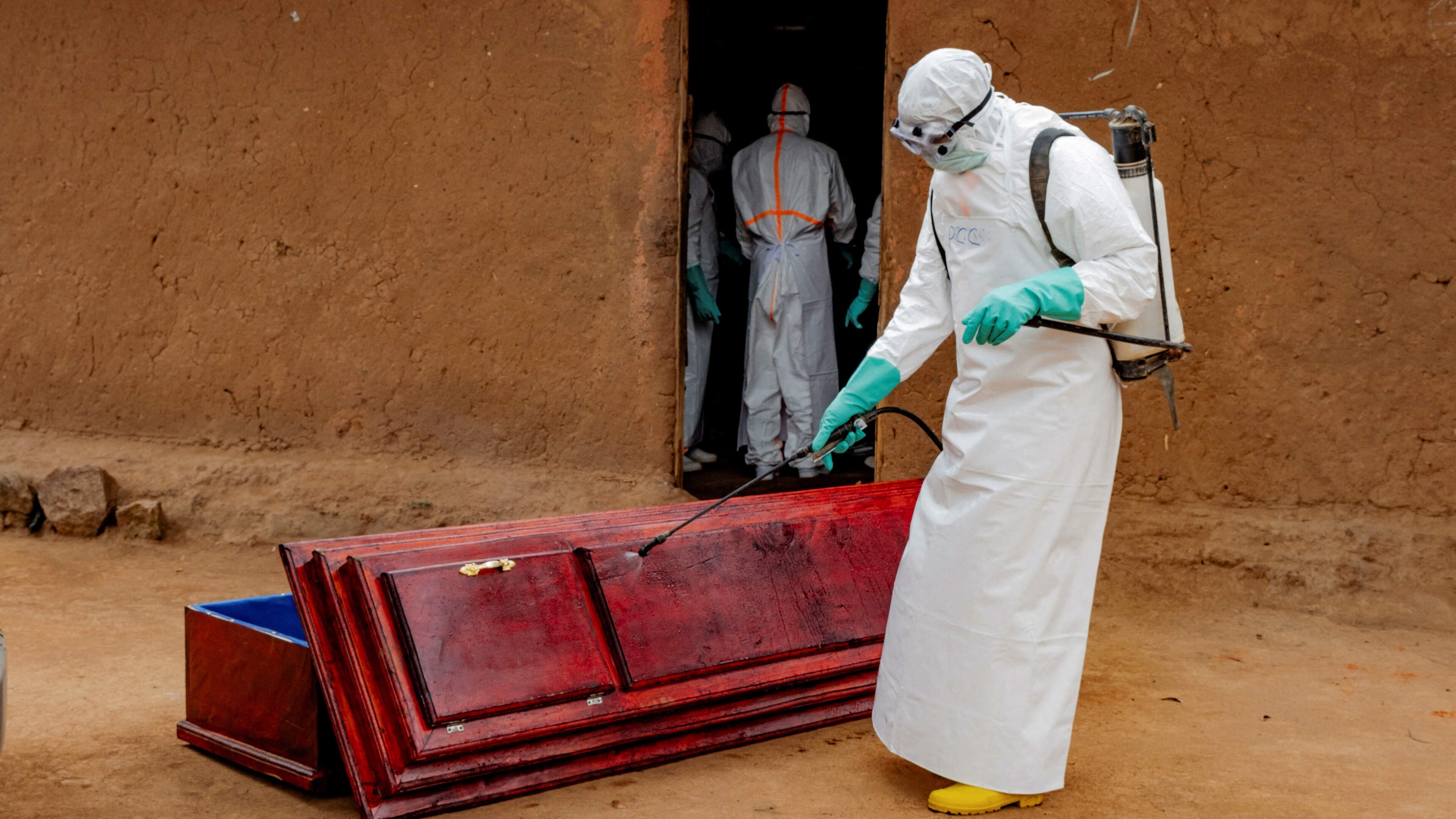
The Ebola outbreak in the Democratic Republic of Congo is showing signs of slowing at its epicentre, but new modelling suggests the infection is spreading further afield, threatening to become the largest ever recorded. The daily tally of new cases in Ituri province, where the outbreak began, was falling at the end of August, but more cases were being found outside the province.
Official figures now say the outbreak has killed more than 3,000 people out of over 6,100 confirmed cases, with the infection spreading faster than any previous epidemic of the viral haemorrhagic fever. Modelling by Airfinity, a health analytics firm, suggests the true toll of cases could be more than four times higher than reported.
What do the latest figures show?
Airfinity said that data from late August showed the seven-day averages of reported cases and reported deaths had fallen by 16 per cent and 18 per cent respectively. However, the firm warned it was 'too early to confirm the decline will hold, and it may mask subnational variation. The outbreak has fluctuated before and a week of falling case and death counts does not rule out another surge.'
The growth in cases had started to ease in Ituri, but had only plateaued in North Kivu province and was accelerating in Haut-Uélé. Overall, the 'outbreak's footprint keeps growing, threatening [to] spread along the Congo river, even as weekly activity seems to ease.'
Why is the outbreak still a global concern?
The US Centres for Disease Control said on Tuesday that efforts to contain the ebolavirus 'remained below established response targets' and the fast expansion of the disease across many health zones indicated 'uncontrolled expansion of the outbreak.'
Epidemiologists are particularly worried about the proportion of deaths among people who are not in hospital and who have not already been traced as vulnerable contacts to other cases. The number of such cases and deaths said to be 'occurring outside known transmission chains' shows that the relief effort has yet to trace and get a grip of how the virus is spreading.
'Until every chain is found and broken, the epidemic will continue and will continue to pose a threat to DRC, its neighbours and the region as a whole,' said Tedros Adhanom Ghebreyesus, the WHO's director-general.
How is the virus spreading?
Health officials have begun using anonymised mobile phone data to map population movements in disease hotspots, giving an indication of where the infection may spread next. Population movement has been an important driver of the spread so far. Ituri's mining industry and its busy towns have been blamed for fanning the outbreak. Officials have also begun checking traffic along the major Congo river transport corridor after cases reached the river port of Kisangani.
'Population movements have always been a factor in outbreaks, but they are particularly important in the current epidemic,' Olivier Le Polain, head of epidemiology and analytics for response at the WHO health emergencies programme, told Reuters.
What treatments are available?
The outbreak is caused by the rare Bundibugyo strain of the virus, rather than the more common Zaire strain, meaning there are no approved vaccines to use to slow the spread. Trials for three potential vaccines should begin by October or November, Dr Tedros said. 'Two new vaccines against Bundibugyo virus are now in safety trials in the UK and Canada,' he said. One is being developed by the US-based Moderna group using mRNA technology and another by the University of Oxford.
The WHO has also recommended a full-scale human trial of Ervebo, a vaccine approved for use against the Zaire strain, to see if it offers any cross-protection against Bundibugyo.
What does this mean for the region?
The outbreak remains on track to eclipse the 2014 West Africa outbreak later this month, to become the largest ever recorded. Airfinity's forecasts give a 50 per cent chance of the outbreak hitting 50,000 cases, double the size of the 2014 West Africa outbreak. As the world watches, the need for a coordinated, humane and effective response has never been more urgent. The people of the DRC deserve our solidarity and our action, not just our concern.