
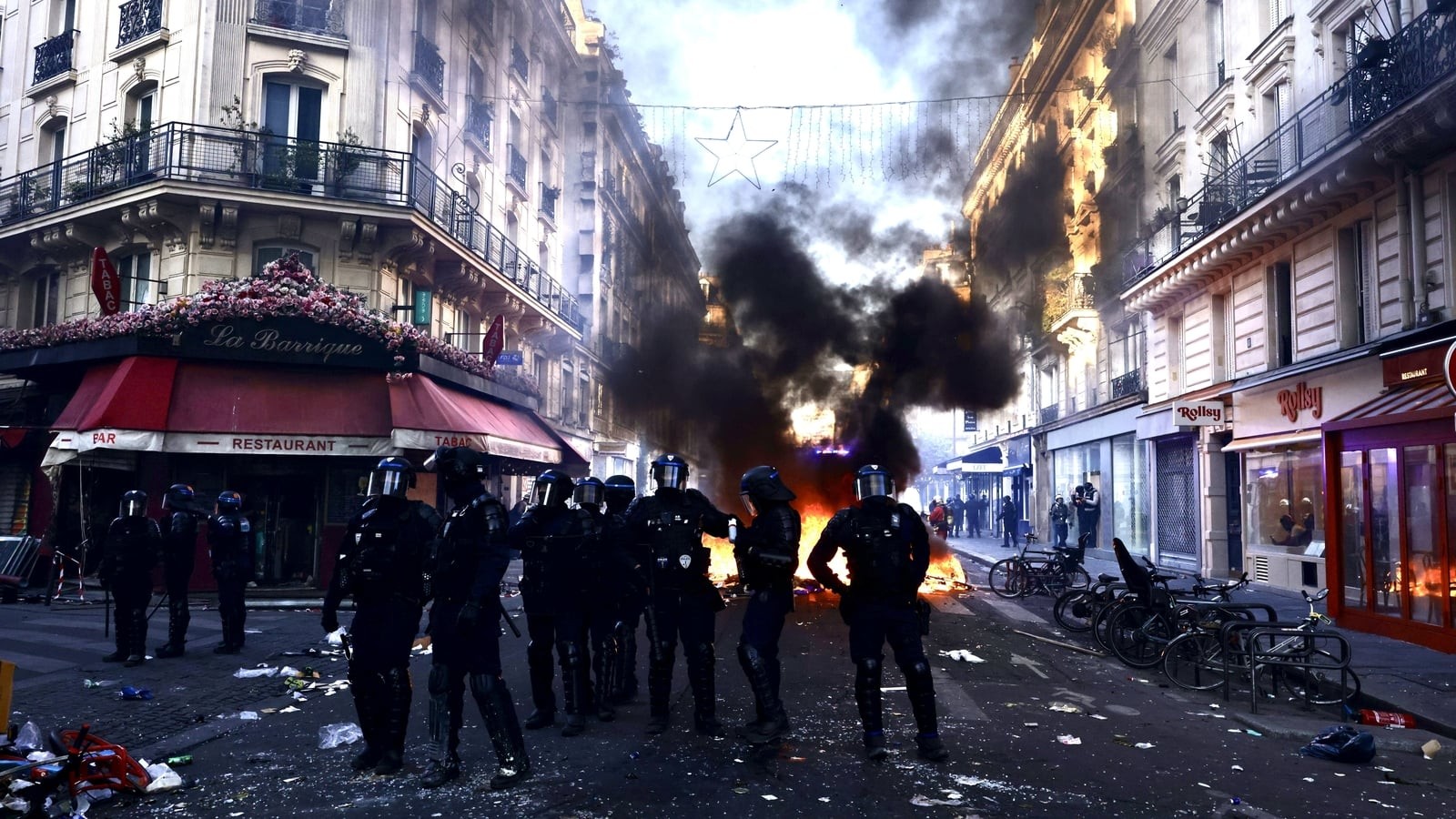
France's Interior Minister Laurent Nunez admitted on Sunday that police “lost control” in some cities during violent protests that swept the country over the weekend, as the government counted at least 2,400 arrests and faced mounting questions about its handling of the unrest.
Nunez said there had been a “lack of anticipation” in preparations and that he had offered his resignation to President Emmanuel Macron “because I felt responsible for everything that happened.” Macron refused to accept it, according to RTE.ie.
The protests, called by a labour union, student organisations and activists hoping to revive the “yellow vest” movement, began as a demonstration against rising living costs and poor conditions in schools. They ended with burning city halls, looted shops and a political crisis that has landed squarely on Macron's desk.
What Happened in Paris and Across France
Authorities estimated Saturday's marches drew about 550,000 people nationwide, while organisers put the figure at 800,000. By Sunday, the arrest tally had climbed past 2,400, approaching the nearly 2,000 recorded during a single day of yellow-vest protests in December 2018.
In Paris alone, police said 855 people were arrested in the capital region, with 557 still in custody on Sunday. Officers used tear gas around Place de la République as small groups tried to set bicycles and rubbish bins alight. Dislodged cobblestones, shattered storefronts and broken glass marked the aftermath.
“The right to protest is a fundamental right. Deliberately and collectively sowing disorder through violence is not,” Nunez wrote on X, citing the looting of hundreds of businesses in Paris, Marseille, Lyon and Bordeaux.
The damage was not confined to the capital. In Limoges, flames engulfed the 19th-century City Hall, causing its roof to collapse and nearly destroying the building. Maurice Barate, prefect of the Haute-Vienne region, said a group of “radical troublemakers” broke in while elected officials, employees, security personnel and members of the public were inside.
“Despite the presence of so many people, they deliberately set the building on fire. It is an extremely serious and unspeakable act,” Barate said.
In Marseille, protesters briefly forced their way into the lobby of City Hall and a masked group damaged a police station. In Lyon, a fire broke out inside a tourist office.
Macron Blames the Far Left as Injuries Mount
Macron, in a televised address to the nation, denounced “unrestrained violence” by “insurrectionist elements from radical far-left groups, joined by numerous criminals.”
“Those who looted will have to pay back for the damage, and those who sought to bring down the Republic will be held accountable,” he said.
The president also expressed the public's “anger” and “shame” over the unrest, a rare acknowledgment of the mood on the streets from a leader whose second term has been dogged by pension reform strikes and rural discontent.
Two serious injuries have sharpened scrutiny of police tactics. In eastern France, the Mulhouse prosecutor's office opened an investigation after a 17-year-old girl lost an eye during the protests. A day earlier, another investigation was opened after a young protester lost a hand in Saint-Etienne. One person died of a heart attack, Paris police said, and the Paris prosecutors' office is investigating.
The injuries come as police face sustained criticism over their use of grenades and other riot-control weapons at recent demonstrations.
A Movement the Far Right Wants to Own
Political leaders across the spectrum moved quickly to convert the fallout into capital ahead of next spring's presidential election.
Far-right leader Marine Le Pen attacked her far-left rival Jean-Luc Melenchon, who joined the Paris march. “Looting, ransacking, destroying and attacking law enforcement: Rioters have again spoiled the October 17 demonstrations for the protection of purchasing power,” Le Pen wrote on X.
US President Donald Trump posted “France is burning!” on his Truth Social platform and appeared to link the unrest to immigration. “Close your borders and take control, before it is too late!” he wrote.
French authorities have not linked immigrants to the rioting. They have repeatedly attributed some of the violence to “radical far-left groups” and others who joined to loot.
For Parisians who watched their neighbourhoods burn, the political jostling rang hollow. Jean Foissy, 74, said he wanted to join the protest but found “a wall of riot police and fires everywhere” and went home.
“I was very scared,” he said. “I've been a Parisian since I was born, so when I got here, it almost made me want to cry because I find it so bad, it hurts me.”
Margaux Eude, 26, said she supports the movement but “didn't think it would escalate like this.”
“It's the troublemakers who came, and it breaks my heart because it delegitimises the movement,” she said.
City Halls Ask for Help as Businesses Count the Cost
Paris mayor Emmanuel Gregoire announced an emergency unit to help businesses assess the damage.
“The scale of the damage is considerable and unprecedented,” Gregoire wrote in an open letter. “Paris is a city of freedoms, debate and demonstrations. It must remain so. But it must also be a city where everyone can work and run a business safely.”
The mayors of Paris, Marseille and Lyon, the country's three largest cities, requested a meeting with the prime minister in the coming days “given the extent of the damage and the seriousness of the situation.”
The unrest has also revived a question that European social democrats have struggled to answer since the 2018 yellow-vest crisis: how to respond to anger over the cost of living without ceding the street to those who want to burn it down. The same pressures are visible elsewhere on the continent, from disputes over food security and rising grocery prices to the wider squeeze on household budgets.
For now, the immediate test is whether the government can restore order and address the grievances that brought hundreds of thousands onto the streets in the first place. Nunez, who offered to fall on his sword, remains in post. The city halls of Limoges and Lyon are counting what is left.
Frequently Asked Questions
How many people were arrested during the French protests?
At least 2,400 people were arrested nationwide, according to authorities. In the Paris region alone, police said 855 people were arrested and 557 remained in custody on Sunday.
What caused the protests in France?
The marches were called by a labour union, student organisations and activists over rising living costs and poor conditions in schools. Organisers hoped to revive the “yellow vest” movement that emerged in 2018 against social injustice.
Did the French interior minister resign?
Laurent Nunez tendered his resignation to President Emmanuel Macron, saying he felt responsible for what happened. Macron did not accept it.
Which cities saw the worst damage?
Limoges saw its 19th-century City Hall nearly destroyed by fire. Marseille's City Hall was briefly breached and a police station damaged, while a tourist office burned in Lyon. Looting was reported in Paris, Marseille, Lyon and Bordeaux.