
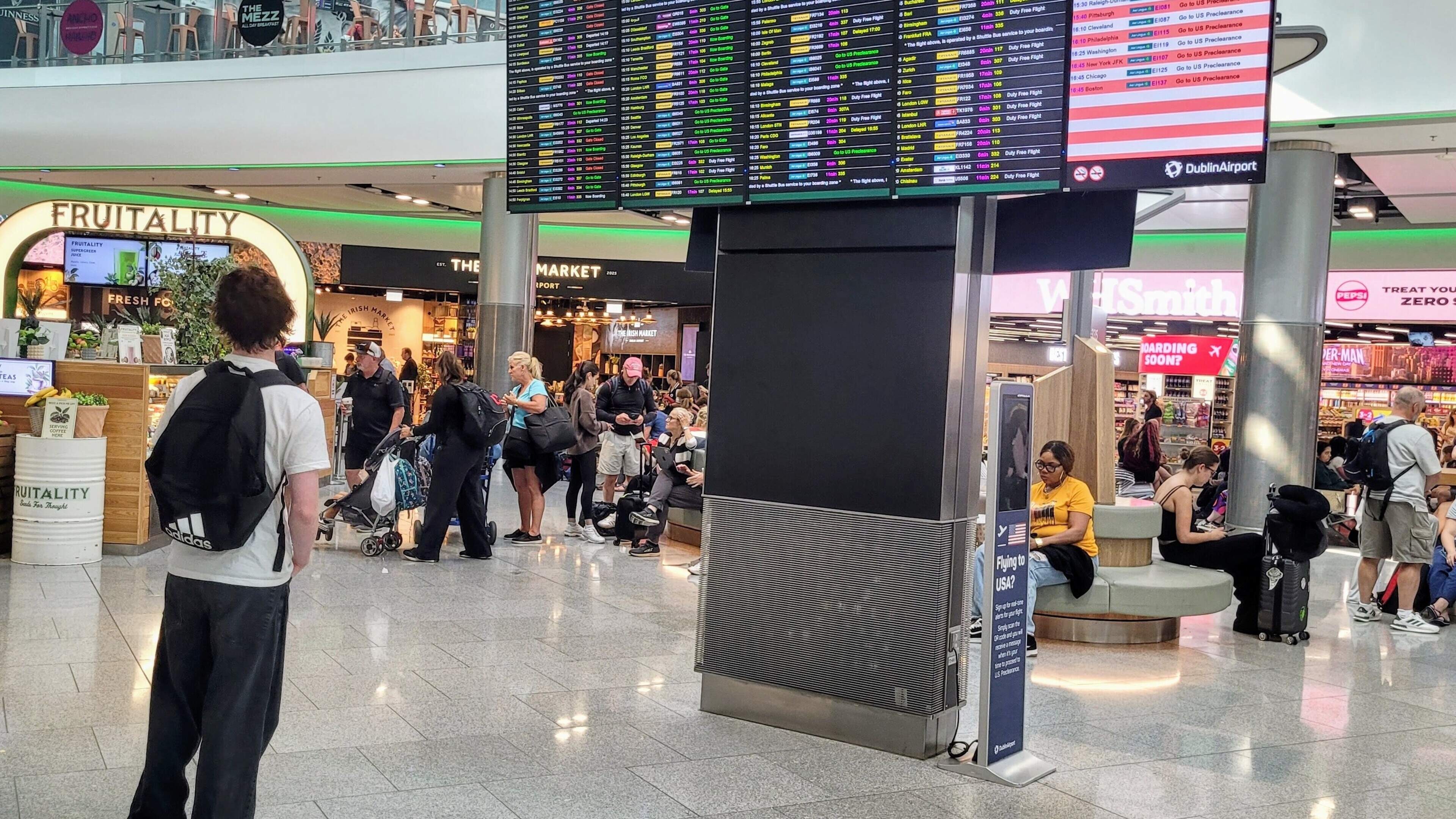
The Court of Justice of the European Union ruled on the morning of 15 October 2026 that the Irish Aviation Authority (IAA) may limit take-off and landing slots at Dublin Airport to keep the gateway within its 32 million annual passenger cap. The judgment, reported by the Irish Independent, leaves the Government with little time to lift the cap before slot allocations for winter 2027-2028 are decided.
The case reaches back to 2024, when the IAA tried to restrict the number of slots it would make available so the airport would comply with a planning condition limiting annual passengers to 32 million. Aer Lingus and Ryanair challenged that move in the High Court, which then referred a set of questions to the CJEU.
What the Luxembourg court actually decided
Earlier this year, an advocate general of the CJEU advised the court that a passenger limit imposed by a planning authority can be taken into account when allocating slots at an airport with capacity problems. The court has now adopted that position in full.
The CJEU held that EU slot rules must be interpreted as meaning that conditions set out in development consents relating to a coordinated airport's infrastructure, and which require compliance with an annual passenger limit, may constitute relevant technical, operational or environmental constraints. Those constraints, the court said, must be taken into account when the coordination parameters for the airport are determined.
The court accepted the practical cost of this reading. It acknowledged that some series of slots may not be allocated to air carriers that would, in principle, be entitled to them.
A cap written into planning law, not market economics
It is worth remembering where this cap comes from. The 32 million limit is not a commercial judgment or an operational safety threshold; it is a planning condition attached to the development consent for the airport's second terminal, a condition that reflects noise and environmental concerns raised by communities living under the flight paths of north Dublin.
Those residents have rights too, and any honest debate about the cap has to hold both truths at once: connectivity matters for an island economy that depends on Foreign direct investment and tourism, and so does the right of people in Swords and Portmarnock to sleep through the night. The CJEU has now confirmed that European environmental and planning law can accommodate both, by allowing regulators to treat a democratically imposed planning limit as a real constraint on how scarce runway capacity is shared out.
Why the Government is running out of road
The immediate political consequence is pressure on the Government to lift the cap before the IAA makes its final determination next April on slots for winter 2027-2028. Unless the cap has been removed by then, the authority will almost certainly have to allocate slots in a way that keeps passenger numbers below 32 million.
The Government passed legislation during the summer allowing the cap to be altered, but the process that legislation sets out is slow by design. When the Transport Minister decides to revoke or amend a planning condition, he must first ask the planning watchdog An Coimisiún Pleanála whether an environmental impact assessment is needed.
ACP must determine whether the proposed order is likely to have significant effects on the environment. Given the scale of the change involved in lifting a limit that shapes the entire operation of the State's largest airport, it is virtually certain the planning authority will decide that it does.
Preparing that assessment will take months. Once submitted, it must then go to public consultation for 30 working days. Even if ACP clears the minister to proceed, an eight-week window opens in which interested parties can seek a judicial review. The whole process could stretch to a year, and possibly longer.
Who wins and who loses while the clock runs
Aer Lingus and Ryanair brought the challenge, and they have now lost it in Luxembourg. The court's reasoning is hard to argue with: a Member State that attaches environmental conditions to infrastructure, through its own planning system, cannot then pretend those conditions do not exist when it sits down to divide up landing slots.
The losers in the short term are likely to be passengers and regional connectivity. If the IAA cuts slot series to stay under 32 million, carriers will shed routes, and the routes that go first are rarely the high-volume trunk routes to London or Amsterdam. They are the thinner links that keep regional Ireland and smaller European cities connected. The contrast with the debate across the water, where Heathrow's leadership is pressing ministers to back a third runway, is instructive: Britain responds to aviation demand with concrete, while Ireland cannot even resolve the allocation of capacity it already has.
There is also a fairness question that the Government should not dodge. If the cap is to be lifted, the communities that carry the noise burden deserve more than a statutory consultation exercise. They deserve insulation schemes, night flight restrictions with teeth, and a share of the economic gains through public transport investment in the corridors the airport depends on. Growth that is not accompanied by redistribution is simply externalised cost.
What happens next
The IAA is expected to make its final determination on winter 2027-2028 slots in April 2027. The Government's task between now and then is to get the legislative process on lifting the cap through An Coimisiún Pleanála, public consultation and any judicial review, or accept that slot cuts will follow.
The CJEU has made clear that the law will not rescue the Government from its own indecision. If the cap stands next spring, the slots shrink with it.
Frequently asked questions
Can the IAA limit slots at Dublin Airport under EU law?
Yes. The CJEU ruled on 15 October 2026 that planning conditions requiring compliance with an annual passenger limit can be treated as technical, operational or environmental constraints that must be taken into account when slots are allocated.
What is the current passenger cap at Dublin Airport?
Dublin Airport is currently restricted to 32 million passengers per year under a planning condition attached to its development consent.
When could the cap actually be lifted?
Legislation passed in summer 2026 allows the Transport Minister to amend the condition, but the process involving An Coimisiún Pleanála, an environmental assessment, public consultation and a possible judicial review could take a year or more.