
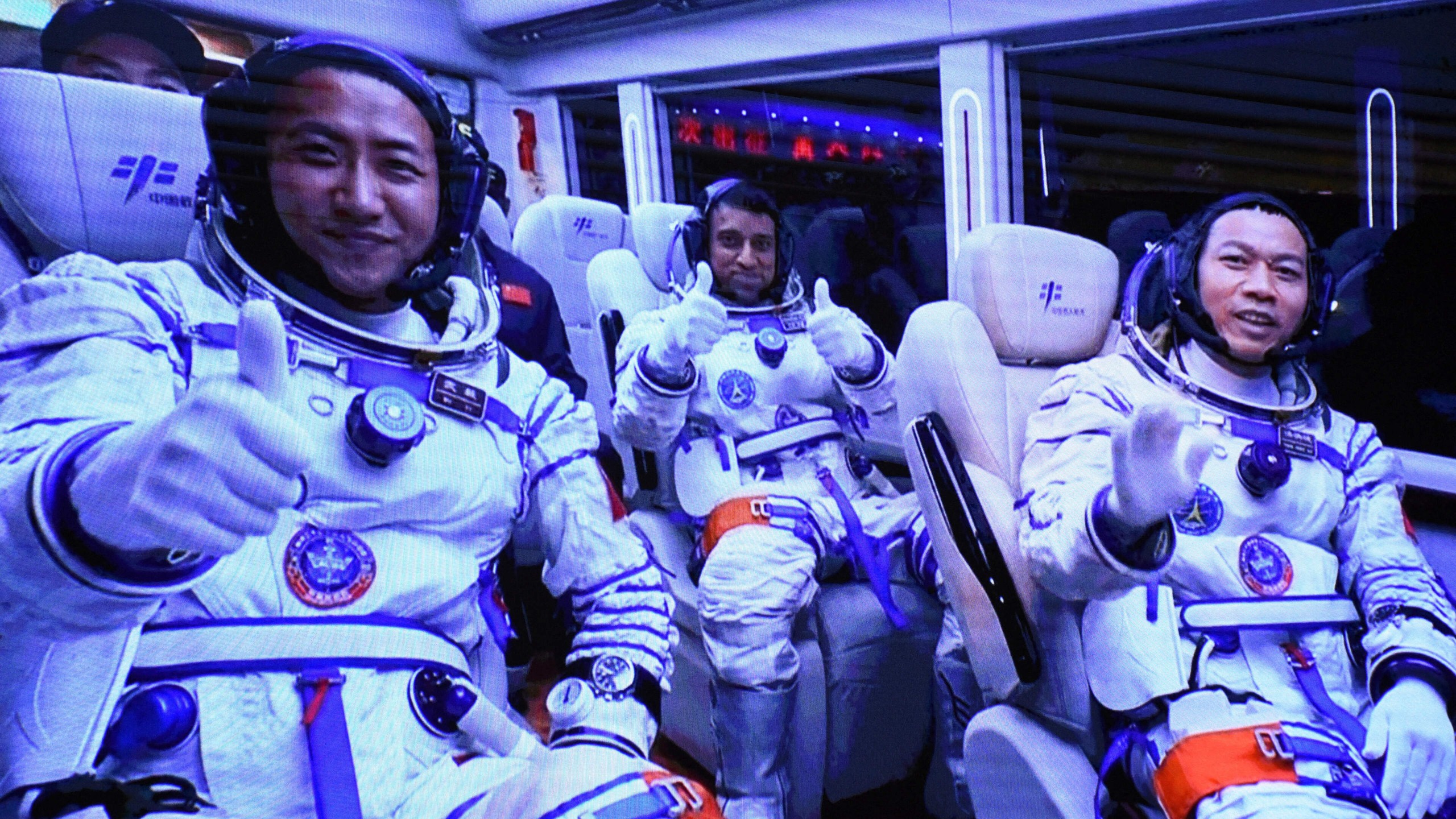
Pakistan's Zeeshan Ali became his country's first astronaut on Wednesday, November 25, 2026, when China's Shenzhou-24 spacecraft carried him to the Tiangong space station.
The 40-year-old payload specialist also became the first foreign national to board the station, according to the Irish Independent's report. His five to ten day stay gives Pakistan a place in orbital research and gives China a visible partner as it invites other countries to use Tiangong.
A short mission after seven months of preparation
Shenzhou-24 docked with Tiangong at 11:56 a.m., or 0356 GMT, about three and a half hours after lifting off from the Jiuquan Satellite Launch Centre in northwest China. A Long March-2F rocket carried Ali, Chinese commander Tang Hongbo and flight engineer Wu Yi into orbit.
Ali, a former Pakistan Air Force pilot, joined the two Chinese astronauts for the flight, India Today reported. He prepared for seven months in Beijing, where intensive Chinese-language classes formed part of his training.
His preparation reached beyond technical instruction. He learned Chinese songs, read Chinese poetry, practised calligraphy and played table tennis, small acts of cultural exchange accompanying a demanding scientific assignment.
Speaking to reporters on Tuesday, Ali framed the journey as a public responsibility rather than a personal achievement.
“I'm not flying for myself. I carry the name of Pakistan on my shoulder,” Ali said.
That distinction matters. A mission lasting days cannot match the six-month rotation usually completed by a Chinese astronaut, but it can still train researchers, test international working methods and widen access to facilities that few states can build alone.
Pakistan watches its first astronaut
The flight prompted celebrations across Pakistan. Students and stargazers filled the auditorium at SUPARCO, the national space agency, before dawn to watch Ali reach orbit, according to Al Jazeera's coverage.
Prime Minister Shehbaz Sharif described the mission as belonging to the country's 240 million people and paid tribute to its younger generation and scientists. He also linked the flight to Islamabad's relationship with Beijing.
“This is living proof of the ironclad friendship between Pakistan and China. We are grateful to our brother country, China, for making Pakistan part of this historic mission,” Sharif said in a post on X.
The public response gives the flight a civic dimension. For Pakistan, a citizen is now working in orbit. For China, Tiangong, whose name means Celestial Palace, has received its first international visitor at a time when the NASA-led International Space Station faces possible retirement by 2030.
Experiments, satellites and a lunar rover
Ali will help conduct experiments during his stay. One will examine whether self-healing carbon fibre composites can automatically repair small cracks in spacecraft, research with potential value for vehicles exposed to the strains of launch and orbit.
Space cooperation between China and Pakistan dates to the early 1990s. China has launched Pakistani satellites, and a Pakistani-built rover is scheduled to fly on a Chinese lunar mission around 2028.
Pakistan's development minister, Ahsan Iqbal, said at the launch site that he hoped the mission would lead to deeper cooperation, potentially including a joint lunar flight. He presented shared scientific work as a practical route for developing countries seeking capabilities tied to future economic development.
“This shows the way forward how developing countries can cooperate to have capability in areas which are very critical for future economic development,” Iqbal said.
His argument reaches beyond prestige. Public investment in science can create skills and institutions that outlast a single flight, while shared missions allow countries with limited budgets to take part in work none could easily finance alone.
What happens aboard Tiangong next?
China's self-built station has been fully operational since late 2022. It can accommodate as many as six astronauts during handovers, when an arriving three-person crew overlaps with the departing crew.
This handover will follow a different pattern. Shenzhou-23 commander Zhu Yangzhu will remain aboard to support China's study of how the human body copes with prolonged life in space. The research will inform preparations for a crewed lunar mission and a possible journey to Mars.
Zhu is due to stay for a year. By the time he leaves, he will hold the record for the longest single stay in orbit by a Chinese astronaut. The other Shenzhou-23 crew members will depart Tiangong alongside Ali.
The wider race to return to the moon
China still aims to establish a human presence on the moon by 2030. That target remains unchanged after its Chang'e-7 lunar mission missed launch conditions this year because of adverse weather linked to a tropical storm.
The United States is targeting 2028 for its return of humans to the moon. Both programmes sit within a contest over lunar bases, which could support eventual human exploration of Mars. China and Russia plan to establish a lunar research base by 2035.
Washington has warned that Beijing could try to dominate access to resource-rich parts of the moon. Beijing rejects that allegation and says it supports the peaceful use of outer space.
Ali's mission does not settle those disputes. It does show that orbital cooperation is already changing, with Tiangong opening its airlock to a partner beyond China while older arrangements approach an uncertain transition.
Pakistan's first astronaut: key questions
How long will Zeeshan Ali stay in space?
Ali is scheduled to remain aboard Tiangong for five to ten days, working as a payload specialist before leaving with the departing Shenzhou-23 crew members.
Why is the Shenzhou-24 mission significant?
The mission makes Ali the first Pakistani in orbit and the first foreign national to board China's Tiangong station, while adding an international research component to China's space programme.
What comes after Ali's flight?
Pakistan and China are preparing a Pakistani-built rover for a Chinese lunar mission around 2028, and Pakistan's development minister has raised the possibility of a joint crewed lunar mission.