
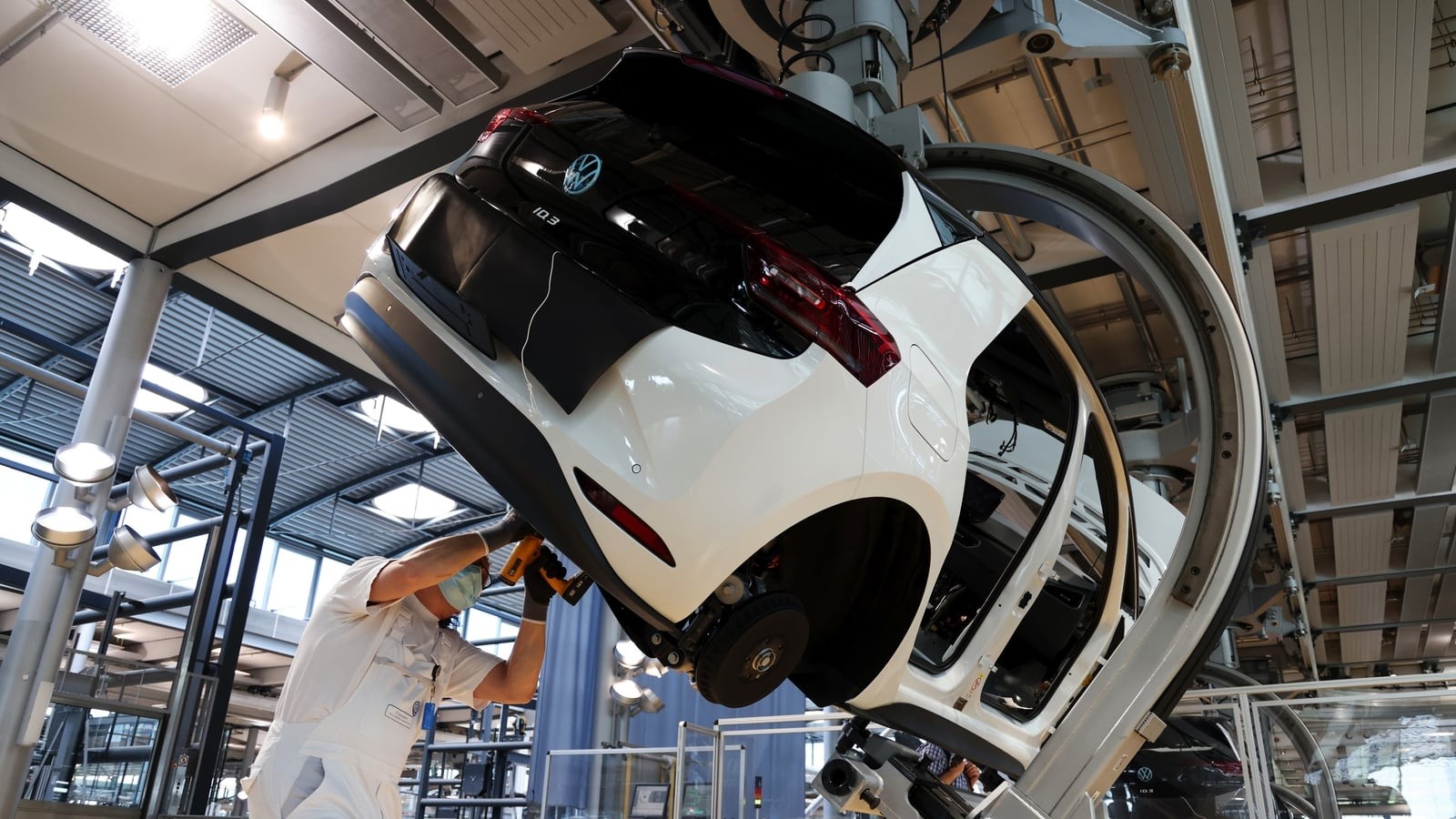
Germany’s largest carmakers and suppliers face months of strikes and difficult wage talks as Volkswagen opens negotiations with IG Metall on Tuesday, November 24, 2026.
The immediate dispute concerns pay and jobs, but its consequences reach further. A industrial settlement built on strong export earnings is weakening under Chinese competition, US tariffs and softer demand, leaving workers to defend conditions while employers demand cuts.
According to RTE.ie’s report on the talks, Volkswagen, Mercedes-Benz, Bosch and Schaeffler are preparing thousands of job reductions, lower investment and possible plant closures. IG Metall has promised determined resistance, raising the prospect of a conflict that will test how the costs of industrial change are shared.
Volkswagen talks set the terms of the dispute
The sharpest confrontation is at Volkswagen, Europe’s biggest carmaker. Management wants further reductions in jobs and salaries, arguing that deep cost cuts are necessary to keep the company competitive.
Thorsten Groeger, IG Metall’s chief negotiator for the Volkswagen wage talks, dismissed the company’s position and said no settlement was possible this year.
“It was out of the question,” Groeger said, describing Volkswagen’s offer as an insult to workers.
The union has threatened strikes from January 1 if the parties fail to agree. One-day stoppages have already affected BMW and Volkswagen’s Audi division, an early indication that the disagreement could spread beyond the negotiating table.
Volkswagen intends to complete a plan for its European factories by the end of June 2027. That plan is expected to address four German sites for which the company has no successor vehicle models scheduled.
The company has said those plants could be converted for military production, given vehicles intended for the Chinese market or, if no alternative is found, closed during the next decade. For the communities around them, each option carries a different implication for employment, skills and local public finances.
Why Germany’s pay model is under pressure
German car workers earn €65 ($71) an hour, the highest hourly pay in the global industry, according to the Kiel Institute for the World Economy. That is more than one-and-a-half times US pay and over three times the rate in Poland.
Those wages were sustained for years by strong earnings abroad, which helped compensate for high labour and production costs at home. Falling returns have made that arrangement harder for manufacturers to maintain.
Volkswagen reported its largest operating loss in more than a decade last month. Mercedes-Benz’s nine-month automotive profit margin fell to 1.9%, compared with 14.9% four years earlier, while BMW’s declined to 3.5% from 8.7%.
Andrew Bergbaum, a partner at consultancy AlixPartners, said weaker investment returns and profitability pointed towards a “difficult winter” in labour negotiations.
“They are in a very difficult place because companies aren’t making any money, they’re not investing any money, and management are increasingly bullish on trying to push through change,” Bergbaum said of the unions.
Daniel Bauer, head of Germany’s SdK investor protection association, framed the dispute as a matter of corporate survival.
“We have to make sure we overcome the current tsunami in the sector and that companies do not go insolvent in the medium term. The IG Metall must know this, too,” Bauer said.
That warning does not settle the central question before negotiators: whether savings will come mainly from wages and employment, or from a credible industrial plan that preserves productive capacity.
Suppliers and workers face a deeper contraction
The pressure is also moving through the supply chain. Research from Roland Berger and Lazard projects average operating margins at European automotive suppliers of 2.9% this year, down from 7.1% in 2018.
Chinese suppliers have experienced a smaller fall, from 9% to 5.8%. The comparison suggests that European parts makers cannot rely on a familiar recovery in demand to restore their finances.
“This is not just another downturn for European suppliers,” said Felix Mogge, a partner at Roland Berger. “Another round of cost cutting is simply not enough.”
Employment figures already show the scale of the retreat. Germany’s federal statistics office says the car industry workforce has fallen to its lowest level in at least 21 years.
Ian Henry of consultancy AutoAnalysis offered little expectation of a quick reversal.
“The fact is for Germany’s car industry, there are going to be more job losses or fewer jobs created, however you look at it,” Henry said.
Marco Santino, a partner at Oliver Wyman, said manufacturers were likely to pursue more structural measures rather than rely on successive reductions in staff. He described the likely approach as “not just these progressive layoffs that are going to reduce capacity, but probably not really solve the problem”.
Investment is moving in different directions
Foreign sales of German-made vehicles fell almost 8% between 2023 and 2025, according to figures from industry lobby group VDA and the federal statistics office. As overseas sales weaken, established manufacturers are producing fewer cars at home.
A contrasting announcement came last week from Tesla, which disclosed a €3 billion expansion of its plant near Berlin. The news arrived four days after Mercedes-Benz said it would suspend investments in Germany.
The contrast complicates claims that high costs alone explain every withdrawal. New entrants are still committing capital where they see a viable product and production strategy, while older companies carry larger workforces, legacy sites and heavier restructuring demands.
For IG Metall, the challenge is to resist a settlement that simply transfers losses to employees without securing future production. For management, repeated short-term savings may preserve cash while leaving factories without new models and workers without a durable route through the transition.
The Volkswagen negotiations will therefore carry significance well beyond one company. Their outcome will indicate whether Germany’s car industry can still combine high wages with investment, or whether the coming months bring plant closures, wider stoppages and a further reduction in industrial employment.
What happens next in the German car industry?
When could Volkswagen workers strike?
IG Metall has threatened strikes from January 1, 2027, if no agreement is reached with Volkswagen. One-day strikes have already taken place at BMW and Audi.
Which German factories are at risk?
Volkswagen has identified four German sites without planned successor vehicle models. Their future is due to be addressed in a European factory plan by the end of June 2027.
Why are German carmakers cutting jobs?
Manufacturers cite weaker demand, Chinese competition, US tariffs and declining profitability. Suppliers and carmakers have also experienced a steep fall in operating margins.