
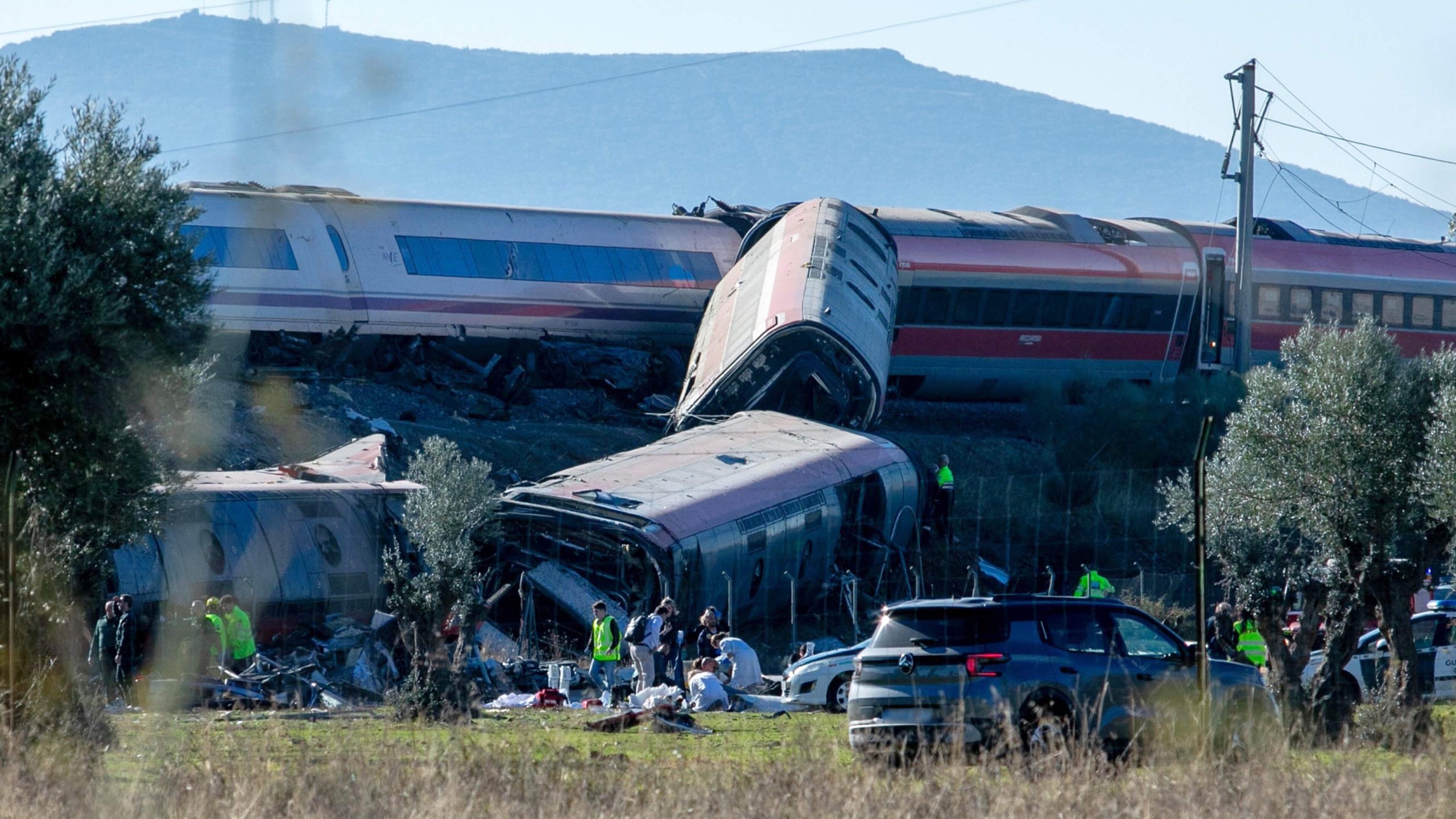
At least 68 people were killed on Wednesday when two high-speed trains collided in Spain, regional authorities said, in the second deadly accident on the same line in less than a year.
The disaster, reported by the Irish Independent, lands weeks before November's snap election and puts the country's rail infrastructure under the harshest political light it has faced in a decade. Spain runs one of Europe's most developed rail networks, used by tens of millions of people every day, and that is precisely why the grief now carries an edge of anger. A system this advanced is not supposed to fail twice in ten months.
A second disaster on the same line
Wednesday's collision follows the crash near Adamuz, in the province of Cordoba, on January 18. Forty-six people died there and more than 120 were injured after a high-speed train derailed and struck an oncoming one.
The Adamuz investigation is still open. A preliminary report by Spain's Civil Guard in February pointed to defects in the track, rail or weld between two sections of track as the main hypothesis, while keeping seven other theories alive. That ambiguity has never been resolved in public, and now the same corridor has claimed more lives.
NBC News reports that the collision has prompted a major national emergency response, with locals rushing to the scene, and that the tragedy has raised questions about the safety of a network previously hailed as among the most sophisticated in Europe. CNN described witnesses recounting devastating scenes, with emergency workers beside a carriage pierced by a track rail at the site where a Renfe AVE train and an Iryo train collided.
Politicians brace for a difficult campaign
The timing is brutal for Spain's political class. The Guardian notes that the death toll has risen to 68 with dozens injured, and that a minister's early comments show an attempt to get ahead of growing public anger over the rail network. The country's opposition leader has already said Spain 'will be rightfully asking questions,' calling for an investigation and a review of the infrastructure.
He is right, and the questions deserve answers rather than spin. When a state runs a rail network, it makes a promise to every passenger who boards: that the track beneath them has been checked, the welds tested, the signals maintained. That promise is a public good, funded by public money, and when it breaks the response cannot be a press release. It has to be a reckoning.
Janos Rozsa, a railway accident investigator and safety specialist, told CNN that investigators will spend the coming days gathering details to understand what led to the collision. The inquiry must be independent, fully resourced and published in full. Anything less will feed the suspicion that convenience is being placed above the dead.
Spain's long and painful rail history
Wednesday's crash joins a grim roll. In July 2013, 80 people died and 145 were injured when an eight-carriage high-speed train left the track on a sharp bend near Santiago de Compostela, slammed into a concrete wall and burst into flames. A Transport Ministry commission blamed speeding and a driver distracted by a call from a superior. A victims' association insisted the fault lay not only in human error but in the railway's security systems, which should have caught the mistake.
That distinction matters. Human error is inevitable; systems exist to catch it. When an inquiry stops at the driver, it often stops short of the truth.
Madrid, 2004: the darkest day
On March 11, 2004, ten backpack bombs detonated on four Cercanias commuter trains during Madrid's rush hour, killing 193 people and injuring thousands. The attacks were carried out by Islamists opposing Spain's participation in the Iraq war. That atrocity sits apart from the safety record, but it belongs in any honest account of Spanish rail and the memory of the country.
Older disasters, older silences
In 1972, a head-on collision on the Cadiz-Seville route near El Cuervo killed 86 people and injured more than 150. An investigation by state-owned operator Renfe found the cause in a driver who failed to stop at a red light.
Two years earlier, in 1970, 33 people died in Urduliz near Bilbao when two trains collided head-on. A stationmaster was initially blamed, until it emerged that he had been working 16-hour shifts for the previous four days. The lesson about exhausted staff and corner-cutting was there half a century ago.
Some tolls were hidden altogether. A fire on a Madrid-Barcelona train at Grisen, near Zaragoza, in 1965 killed dozens; the operator said 30 at the time, but later reports put the real figure at up to 80, with the Francoist leadership accused of playing it down. The 1944 Torre del Bierzo crash in Leon province, where a brake failure sent a Madrid to A Coruna train into a locomotive inside a tunnel before a third train struck the wreckage, remains one of the deadliest in Spanish history, with an estimated death toll of 78 still debated because of censorship under Francisco Franco.
What Ireland should take from this
There is a lesson here for every European country that has invested in rail, and for Ireland in particular. Public transport is one of the greenest, most redistributive things a state can build. It carries workers, students and pensioners who cannot or choose not to drive, and every euro spent on it is a euro spent on ordinary people's freedom to move. But the case for rail rests on trust, and trust is maintained through maintenance.
Spain's network is a genuine public achievement, and one crash, or even two, does not erase that. What would erase it is a political habit of cutting inspection budgets, deferring renewal works and hoping the safety record holds until after the election. Voters in Spain will go to the polls in November with this grief fresh. The least the state owes them is a full account of what happened on that line, and a binding commitment to fix it, before the campaign posters go up.
FAQ
How many people died in the Spain train crash?
At least 68 people were killed when two high-speed trains collided in Spain on Wednesday, according to regional authorities, with dozens more injured.
Has this rail line had a crash before?
Yes. In January 2026, 46 people died near Adamuz in Cordoba province when a high-speed train derailed and collided with an oncoming one. A preliminary Civil Guard report pointed to track defects as the main hypothesis.
When is Spain's snap election?
Spain holds its snap election in November 2026, weeks after the collision, which means rail safety will be a central campaign issue.
What caused the crash?
The cause has not yet been confirmed. Investigators, including railway safety specialist Janos Rozsa, are gathering details to determine what led to the collision.