
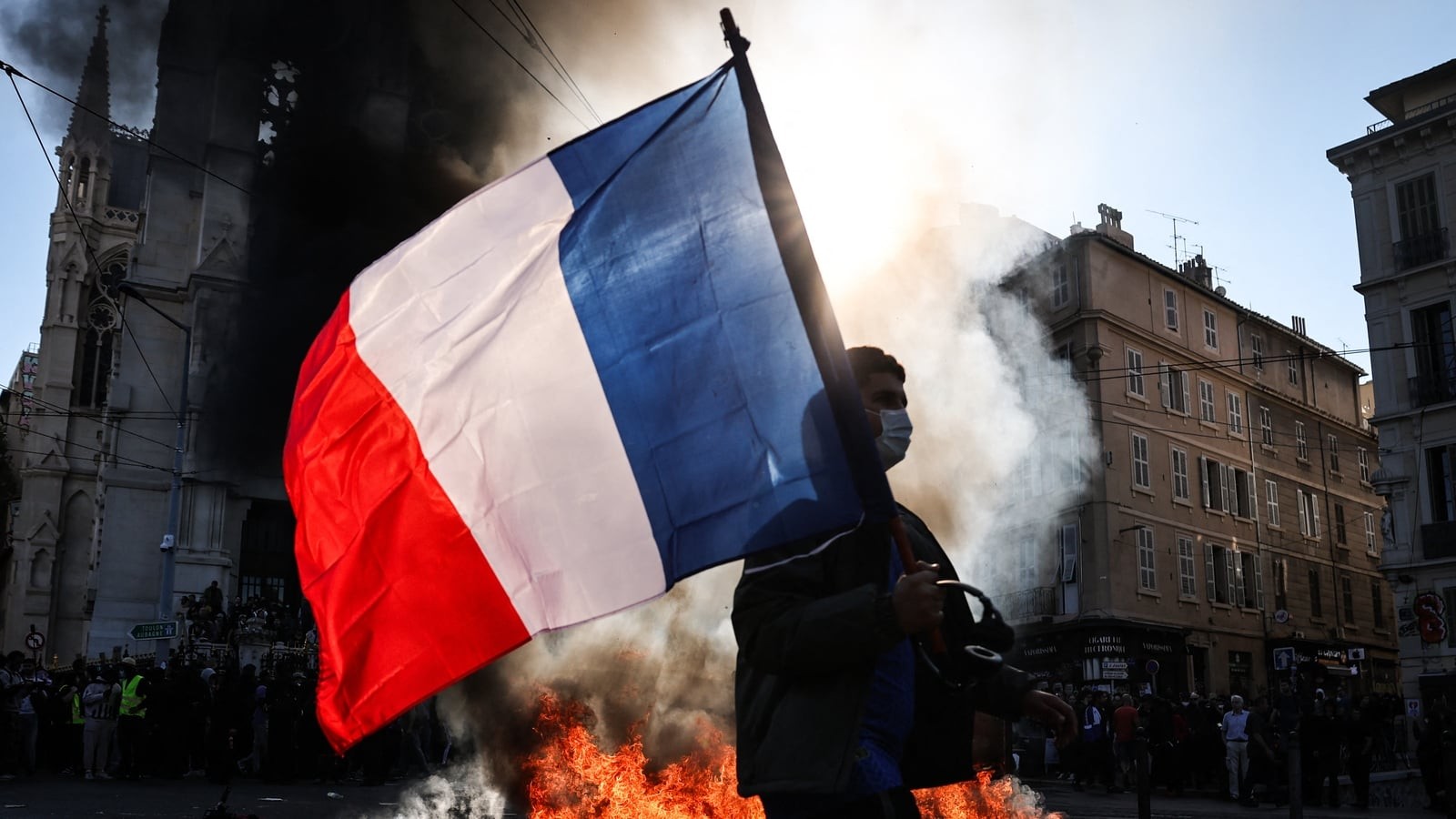
Ten days after the worst street violence France has seen in years, the country's political class is picking through the wreckage and asking one question: who benefits when a republic looks like it has lost control? The answer, for now, is Marine Le Pen, and that should trouble everyone in Europe who believes in a social state that works.
According to RTE.ie, the riots of Saturday 17 October, which saw nearly 1,500 businesses looted or vandalised and town halls stormed in Marseille, Lille, Angers, Limoges and Bordeaux, have become a national trauma. Fabrice Février, director of the Media Observatory at the Jean Jaurès Foundation, called the date one that French people will mention for decades without needing to specify the year.
What began as a school protest movement over neglected education, as Demócrata reported, widened into a broader mobilisation on the cost of living. Around 550,000 people demonstrated peacefully across the country. By late afternoon, Black Bloc activists, the so-called casseurs, had hijacked the day, and opportunistic looters followed them. President Emmanuel Macron, speaking after a meeting with ministers and intelligence chiefs, described the violence as seditious acts by ultra left groups whose aim was to bring down the republic. The intelligence failure that let it happen has already produced resignation offers, according to Fox News.
A debt crisis hiding behind a political crisis
The deeper problem is that France has almost no room to respond. Its debt to GDP ratio reached 119% at the end of June, against 59.3% in 2001, with a budget deficit of 5.1%. The premium on French ten year bonds over German ones hit a 15 year high last week. This year the state spent more servicing its debt than it spent on education. For a country that prides itself on its schools and its public services, that single statistic tells you how far things have slipped.
Macron defused the Gilets Jaunes protests of 2018 to 2020 with €10 billion in tax cuts. He cannot do it again. Since his decision to dissolve the National Assembly in 2024 he has no majority, no budget, and borrowing costs that climb every time the wars in Iran and Ukraine push up energy prices. Shahin Vallée, senior associate fellow at the German Council on Foreign Relations, warned that France's fiscal woes could shake Europe to its core in the coming months.
There is a hard truth here for those of us who believe in the social state. France spends over €440 billion a year on pensions, 14.1% of GDP, and disposable income for the over 65s runs at 94% of the population average against an OECD norm of 87%. The Brussels think tank Bruegel says plainly that this level of social spending is unsustainable without reform. When a republic cannot fund its schools but protects its pensions untouched, it stores up exactly the anger that exploded on 17 October.
Who gains from the chaos
Le Pen launches her campaign for the Élysée this weekend in Orléans, polling at between 34% and 38% for the first round. She has been careful to pin the blame on Macron's government rather than on immigrants, though her deputy Jordan Bardella told CNews that a large proportion of the looters were people from immigrant backgrounds who hate the country. That is the oldest trick in the far right playbook, and it is working because the centre left has ceded the ground on living standards.
Her deputy's rhetoric aside, Le Pen's own pitch is now couched in the language of fiscal responsibility that would have been unthinkable in 2017. She proposes a golden rule against runaway deficits, a halving of France's EU contribution, and cuts to welfare for immigrants, savings she claims at €140 billion. Critics say the numbers do not add up, and they note she helped bring down two Macron prime ministers who tried to rein in the deficit.
On the left, Jean-Luc Mélenchon of La France Insoumise sits at 16%, ahead of the centre left's Raphaël Glucksmann on 13%. A Cluster17 poll found nearly half of 18 to 24 year olds would vote for him. He has built real support among the young people who took to the streets over schools and living costs, and that support is earned, not bought. But his €82 billion spending package, funded by a wealth tax and inheritance taxes, is topped by a pledge to cancel €488 billion of debt by converting bonds into perpetual instruments held by the ECB. ECB President Christine Lagarde called it illegal. Banque de France Governor Emmanuel Moulin called it dangerous and useless. Mélenchon responded that he would prosecute Moulin for treason if elected. That is not the language of someone who intends to govern a republic.
The runoff scenario that should worry Europe
Le Pen leads Mélenchon 67% to 33% in a runoff, according to Toluna Harris Interactive, and few in Paris doubt that she would prefer to face him rather than a moderate like Édouard Philippe or Gabriel Attal, both stuck around 15% and both weighed down by their years as Macron's prime ministers. Mujtaba Rahman of Eurasia Group put it bluntly: a runoff between the two extremes would trigger a substantial bond market sell off, forcing whoever wins into fiscal adjustment of historic proportions.
For Ireland, and for every small economy tethered to the euro, that is the real risk. France is too big to fail, but a bailout for a country that refused the pension reforms everyone else endured would place unbearable strain on the single currency. The markets are already pricing in the possibility that a Le Pen presidency combines attacks on the EU with demands for ECB help, a contradiction voters may not see until it is too late.
What happens next
The Rassemblement National must soon decide whether to back Macron's next budget, which cuts the deficit by just 0.4%, or reject it and bring down the government. Either way, Le Pen enters her fourth bid for the Élysée in the strongest position of her career, riding a populist wave that could put eurosceptic parties into government in Spain, Portugal, Italy, Poland and Greece. One diplomat told RTE that the shops around the Marais are boarded up ahead of the Christmas shopping season, and French economists fear a spiral of recession and debt arriving together. Six months out, The Straits Times notes that the turmoil may yet open space for Glucksmann against both Mélenchon and Le Pen. Polls show 60% of voters could still change their minds. There is time, but not much of it, for the French left to offer something better than chaos.
FAQ
When is the French presidential election?
The first round is due next April, with the runoff roughly two weeks later. It will be Le Pen's and Mélenchon's fourth attempt each at the Élysée.
How bad is French public debt?
France's debt to GDP ratio stood at 119% at the end of June 2026, with a 5.1% budget deficit, and debt servicing this year cost more than education spending.
Who is favourite to win?
Polls put Marine Le Pen at 34% to 38% for the first round. She leads Jean-Luc Mélenchon 67% to 33% in a runoff, though 60% of voters say their intentions could change.