
Europe is under sustained attack in a gray zone between peace and war, and the weapons are false bomb threats, GPS jamming, burned cables and recruited teenagers. That is the picture drawn by RTE.ie in an investigation published on 12 November 2026, drawing on reporting by Pilar Requena of RTVE, which maps a campaign of sabotage and cyberattacks that has already touched Irish shops and Irish skies.
The most recent wave is startling in its banality. Over one night, 1 and 2 November 2026, attackers compromised the cooling systems of more than a hundred supermarkets and food stores across at least nine European countries, including Ireland, Belgium, Sweden, Finland and Portugal. Food spoiled on the shelves. Nobody entered the buildings. The intrusion was done remotely, through connected industrial controllers.
What is hybrid warfare and why does it target Europe?
Hybrid warfare is confrontation without a declaration of war. The House of Commons Library notes that there is no universally accepted definition, but the former head of MI6, Sir Alex Younger, described it in January 2025 as everything that stays below the threshold of war, from disinformation to sabotage to cyber or economic coercion.
The instruments are old: espionage, propaganda, economic pressure. What is new is the combination and the speed. A campaign can start with a fake email, pass through a cyberattack, rely on online recruits and end in a fire at a warehouse or a crisis at a border. The purpose is often not destruction but division, weakening trust in governments and convincing citizens that nothing is safe.
False threats, real disruption
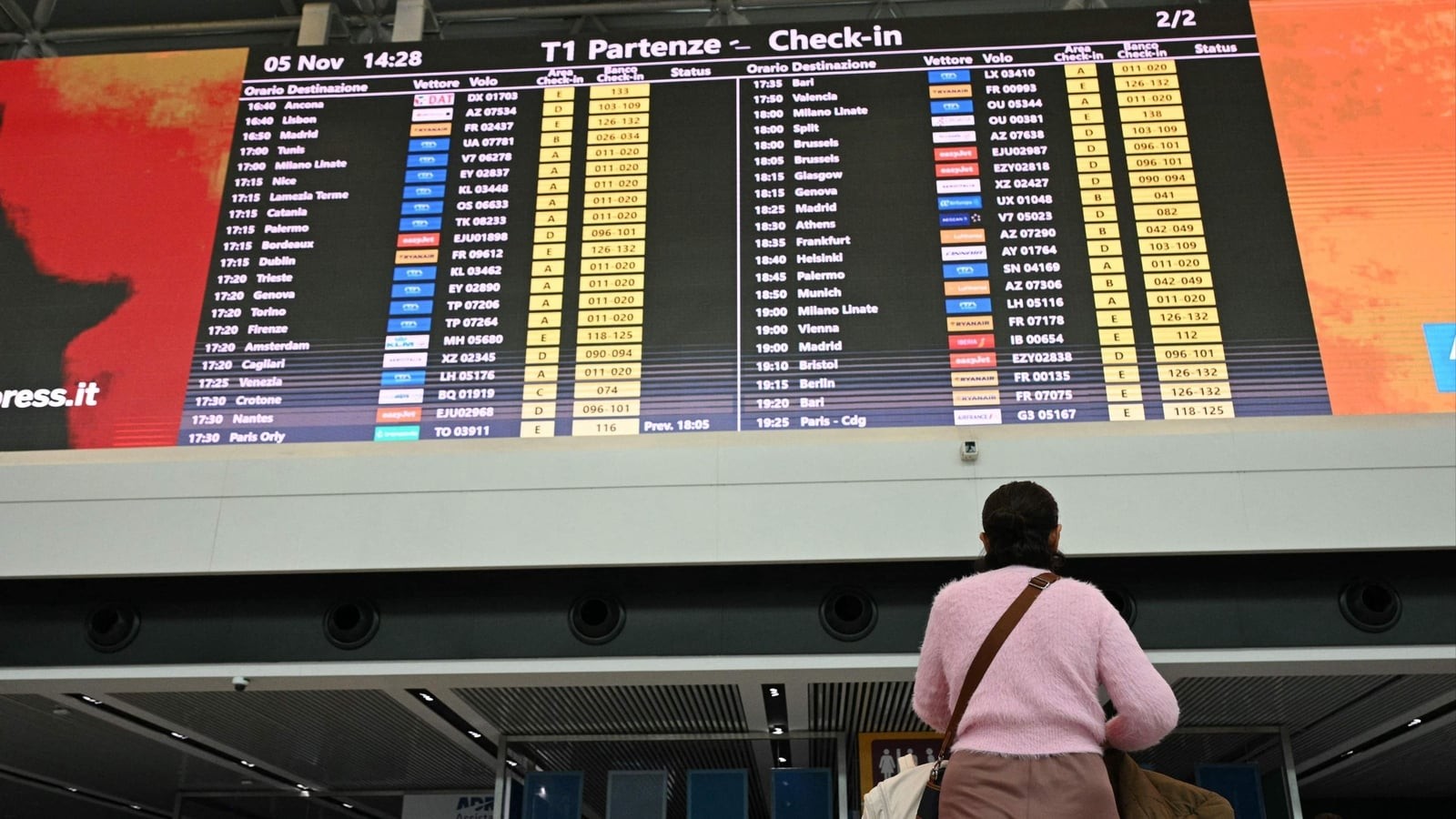
A wave of false bomb threats against commercial planes disrupted European air traffic in recent weeks. No explosives were found, yet every message triggered emergency protocols, diverted flights and evacuated passengers. The same week, more than 6,000 Italian schools received similar threats. The operation produced real effects without a single bomb.
Since Russia's invasion of Ukraine in February 2022, the European Union Aviation Safety Agency has recorded a significant increase in interference with satellite navigation systems, concentrated around the Baltic, the Black Sea, the Mediterranean, the Middle East and the Arctic. In October 2025, the Assembly of the International Civil Aviation Organization formally condemned Russia for harmful interference affecting air operations in Europe, acting on evidence presented by Estonia, Finland, Latvia, Lithuania, Poland and Sweden.
The Atlantic Council reports a surge in suspected Russian hybrid warfare incidents across the continent, ranging from assassinations and cyberattacks to infrastructure sabotage and disinformation campaigns. But the RTE.ie reporting is careful on one point: not every incident can be pinned on Moscow, and in hybrid warfare confusion can itself be the objective.
Disposable agents: sabotage outsourced to strangers
The expulsion of dozens of Russian diplomats from Western countries after the invasion of Ukraine reduced Moscow's traditional operational presence in Europe. In its place came what investigators call disposable agents: people recruited through social media, job platforms and volunteer forums, paid by the task.
In September 2026, the EBU Investigative Journalism Network exposed one such network operating in Lithuania, Poland, the Czech Republic and Romania. Many recruits were young Latin Americans. The investigation identified Oemis Romagoza Durruthy and Alexeis Pecora, both of Cuban origin and Russian citizenship, living in Russia, as central figures. According to the Lithuanian Prosecutor's Office, the plot was connected to Russian military intelligence, the GRU.
The pattern matters for how democracies defend themselves. Operations that once required trained operatives can now be assigned to inexperienced individuals recruited remotely, which makes attribution harder and deniability easier.
Not only Russia: Iran, China and Morocco
The gray area is a crowded space. On the night of 11 and 12 October 2026, the cooling systems of around 700 French retail establishments were compromised, with defrosting parameters altered and temperatures raised. On 9 November, the French government attributed the operation to the Shahid Kaveh cyber unit linked to Iran's Revolutionary Guard Corps, citing technical evidence, infrastructure and linguistic traces in Persian.
Attacks also reached refrigeration units at three regional centres of the French Blood Establishment. Staff moved reserves to unaffected refrigerators, and the Ministry of Health confirmed the blood supply was untouched. Still, the signal is clear: the hybrid threat is not a geopolitical abstraction. It shows up in a cold storage facility, a food warehouse, a blood bank.
China operates differently, through influence campaigns and transnational intimidation aimed at narrowing the space for criticism of Beijing. Morocco, meanwhile, has used migration flows as a form of political coercion, as with the entry of around 100,000 people into Ceuta on 30 July. These are distinct threats requiring distinct responses, and the RTE.ie report warns against turning hybrid threat into a catch-all label.
What Europe must do now
Undersea cables, ports, energy grids and water systems are extensive, hard to monitor and often privately owned. Protecting them requires cooperation between governments, businesses, armed forces and security agencies, and a capacity to share information quickly across borders. Ireland, with its strategic position on Europe's western edge and its concentration of data centres and subsea cables, has more skin in this game than most.
There have been successes. In July 2025, an operation coordinated by Europol and Eurojust and led by Spain dismantled more than a hundred servers used by the pro-Russian hacktivist group NoName057(16). The group survived, but the operation showed that coordinated European action can land real blows.
As CNBC has reported, the defining feature of hybrid warfare is destabilization without open military conflict. The battlefield, in the end, is trust: in airplanes, in food, in water, in institutions. That is a battle an open society can win, but only if it names the threat honestly and defends its people together, across every border in Europe.